Searches for SSEG application have climbed because more South African homes now have inverters on the wall — and more owners are realising that a working solar plant is not the same thing as a legal one. Compliance is not a software tick-box. It is a stack of code, inspection, and utility permission. Skip any layer and you can lose insurance cover, trip a prepaid meter, or energise a circuit that can kill a linesman during an outage.
This article explains what “legal” means under South African SABS / SANS wiring rules, why an SSEG application is required even if you never sell a kilowatt-hour, and how to tell an inverter fault code that needs a basic reset from one that needs a technical assessment.

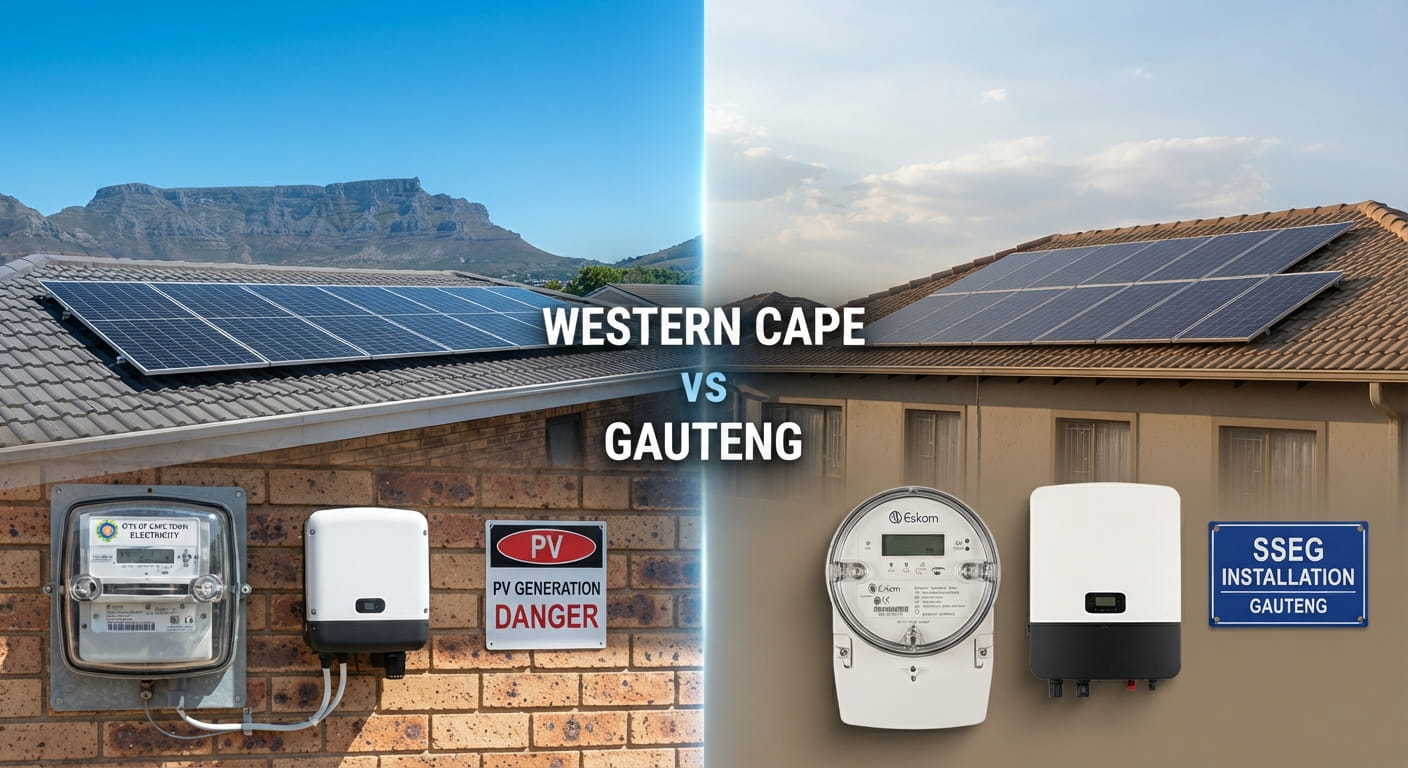
Figure 1 (suggested hero): Legal SSEG in one frame — rooftop array, labelled AC/DC isolators, and a meter kiosk with dual-supply / embedded-generation stickers.
What “legal solar” actually means
Under Schedule 2 of the Electricity Regulation Act, any generator that is electrically connected to the distribution network — including a hybrid inverter on your DB — is Small-Scale Embedded Generation. The distributor (Eskom or the municipality) must know it is there before you switch it on.
A system is generally treated as compliant when all of the following are true:
- You submitted an SSEG application to the correct distributor and received permission to install (and later, permission to energise).
- The installation was built to the national wiring code — SANS 10142-1, still widely searched and spoken of as the SABS wiring code.
- A Department of Employment and Labour registered person completed an inspection and issued a Certificate of Compliance that covers the PV and inverter circuits.
- The inverter is NRS 097-2-1 certified, with anti-islanding enabled and the South African grid code selected.
- Metering matches the design: reverse-power blocking if you do not export, or an approved bi-directional / AMI meter if you do.
If the plant is a true off-grid island with a physical break from the grid, the SSEG file is different — but the SABS/SANS CoC for the premises wiring still applies. See our guides on Eskom SSEG registration and Western Cape vs Gauteng municipal timelines.
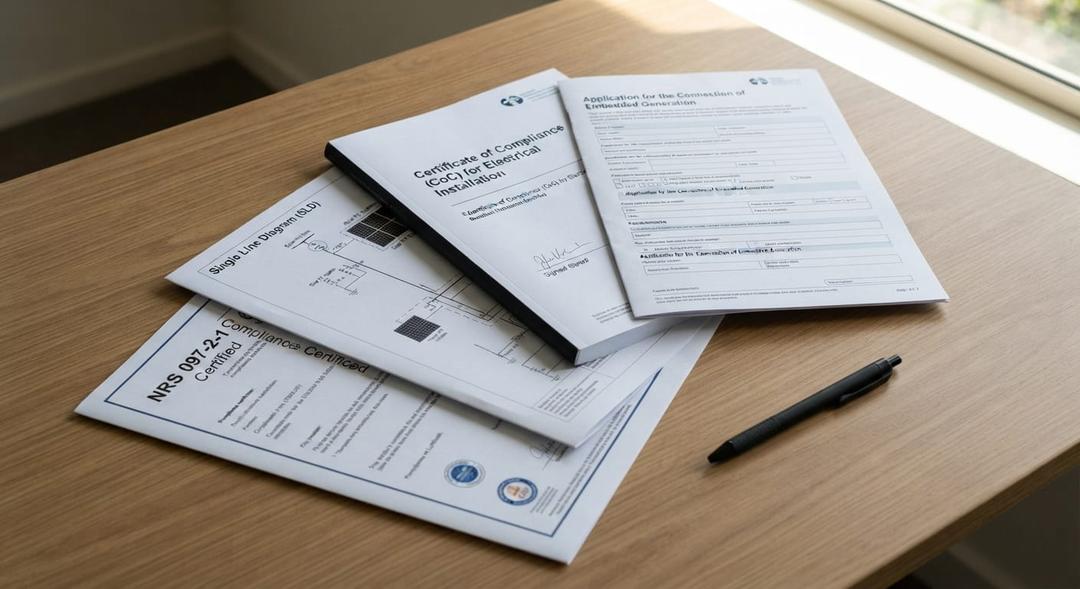
Figure 2 (suggested): Flat-lay of the compliance pack — SSEG application, CoC, SLD, and inverter NRS certificate. This image targets the “SSEG application” search intent.
Why non-compliance is expensive
Unregistered systems are not a paperwork technicality. They create four practical failures:
- Safety: Without tested anti-islanding, the inverter can keep a “dead” street live while Eskom or municipal crews work.
- Insurance: After a DB fire or surge, many policies ask for a valid CoC and proof the alteration was inspected. No inspection, no payout argument.
- Metering: A normal prepaid meter treats reverse energy as tamper. Owners then hunt for a “reset code” when the real issue is illegal export.
- Resale and finance: Conveyancers and banks increasingly ask whether alterations (including solar) have a current CoC.
Energising first and applying later is how files get cancelled and restarted. Cape Town, City Power, and Eskom all treat switch-on before commissioning approval as an unauthorised connection.
| Item | Legal System | Non-Compliant System | Risk If Skipped |
|---|---|---|---|
| SSEG application lodged with Eskom or your municipality before switch-on | Written permission to install and commissioning / connection approval on file | Inverter already exporting or islanding on the house wiring with no utility file | Illegal connection, forced isolation, and possible reconnection conditions |
| Electrical inspection and Certificate of Compliance (CoC) | DoEL-registered electrician issued a CoC covering SANS 10142-1 embedded generation | No CoC, expired CoC, or CoC that never mentions the PV/inverter circuit | Insurance repudiation after fire or surge; sale of property blocked |
| Wiring to the national code (SABS / SANS) | Correct isolators, earthing, bonding, SPDs, cable sizing, dual-supply labels | DIY tails into the DB, shared neutrals, missing DC isolator, no dual-supply warning | Shock hazard to occupants and municipal / Eskom field workers |
| Inverter listed and set to NRS 097-2-1 | Type-tested anti-islanding inverter on the distributor's accepted list, SA grid code enabled | Grey-import inverter, EU grid code, or anti-islanding defeated | Back-feed during outages; application refused; dangerous islanding |
| Metering matches export intent | Reverse-power blocking for non-export, or approved bi-directional / AMI meter for feed-in | Standard prepaid meter seeing reverse energy (tamper lockout) | Lost credit, lockout, and a compliance investigation |
SABS, SANS, and the inspection you cannot skip
People search SABS because that is the historic brand on South African electrical standards. The live wiring code for premises is SANS 10142-1 (with the embedded-generation requirements). SABS remains the standards body people recognise; the inspecting electrician works to SANS.
A proper inspection is not a visual glance at the roof. The registered person tests continuity, insulation resistance, earth leakage, isolator function, and that labels match the as-built plant. Only then should they sign the CoC. If your CoC predates the solar and never mentions the inverter circuit, it does not cover this installation.

Figure 3 (suggested): Hands-on inspection photo — insulation tester on the inverter AC isolator, CoC pad visible. Supports keywords Inspection, Code, SABS.
Distributors may still do a desktop or site inspection of labels at the supply point, meter type, and whether the as-built matches the SSEG application. Passing the electrician’s CoC does not replace that letter.
| Check | Who Performs It | What They Verify | Pass Document |
|---|---|---|---|
| SANS 10142-1 (SABS wiring code) inspection | DoEL registered Installation Electrician or Master Installation Electrician | AC/DC isolation, earthing, bonding, SPDs, DB changes, cable ratings, labels | Electrical Certificate of Compliance (CoC) with embedded-generation coverage |
| NRS 097-2-1 inverter compliance | Manufacturer / accredited test body; installer confirms model and settings | Anti-islanding, voltage/frequency trip, reconnection delay, SA country code | Inverter NRS 097-2-1 certificate and nameplate matching the SSEG application |
| Single-line diagram vs as-built | Installer and inspecting electrician | Array, isolators, inverter, changeover, meter, earth, generation breaker | SLD submitted with the SSEG application; as-built update if the plant changed |
| Distributor commissioning / connection inspection | Municipality or Eskom (desktop review; site visit if they elect to inspect) | Permission, CoC, dual-supply labels at the supply point, meter type, no premature energising | Commissioning approval or permission-to-connect letter |
Fault codes: reset the inverter, or is the system not legal?
Inverter screens speak in fault codes. Portals speak in statuses. Meters speak in tamper flags. Mixing them up is how owners reset a legal protection feature and call it a repair.
Worth a basic reset
- Grid-loss or islanding codes during load-shedding or a local outage (anti-islanding is required compliance).
- AC voltage / frequency out of range for a few minutes after restoration, then a normal reconnect.
- A European grid-code setting that you can legally change to the South African NRS 097-2-1 profile without defeating protection.
Not a reset — book an assessment
- Prepaid tamper after the solar started.
- Repeated ISO / ground-fault / RCD trips.
- Commissioning refused because the SLD, earthing, or inverter model fails the code.
- The plant has been running for months with no SSEG application at all.

Figure 4 (suggested): Split image — inverter LCD fault vs prepaid meter tamper. Visual for “reset vs assessment”.
Use the table below as a first diagnosis. If a step says “shut down” or “always assess”, do not keep power-cycling.
| Scenario | Recommended Step | When To Book Assessment |
|---|---|---|
| Inverter fault code for grid loss, islanding, or AC voltage/frequency after load-shedding | Confirm the municipal/Eskom supply is restored. Cycle DC then AC isolators per the manual. Verify the inverter country/grid code is South Africa (NRS 097-2-1), not a European default. | If the same code returns on a healthy grid, or the unit never reconnects after the legal anti-islanding delay. |
| Prepaid meter tamper / reverse-energy lockout after solar was switched on | Shut the inverter down immediately. Do not keep resetting the meter. This is usually unapproved export, not a glitch. | Always — you need an inspection of metering, reverse-power blocking, and SSEG application status before the system is legal to run. |
| SSEG application returned: incomplete CoC, missing SABS/SANS references, or unsigned inspection forms | Read the rejection. Book the electrician to re-inspect and reissue the CoC. Do not rewrite the form yourself to 'make it pass'. | If the inspector flagged earthing, isolators, or as-built wiring that does not match the code. |
| Insulation / ISO, ground-fault, or residual-current fault on first start | Isolate PV strings. Do not bypass earth-fault protection. Check for wet MC4s only if you are competent and the isolators are off. | If the code repeats — this is a safety and compliance fault, not a portal paperwork issue. |
| System runs, but you never lodged an SSEG application | Do not 'reset' anything to hide export. Switch to non-export only if reverse-power blocking is already installed, then start the legal application. | Yes — a compliance assessment documents what is installed so the SSEG application and inspection can catch up without a dangerous rework. |
How to regularise a system that is already on
If the inverter is live and you never filed an SSEG application:
- Stop export. If you cannot prove reverse-power blocking, switch the inverter off until an electrician confirms it is safe.
- Identify the distributor on your account (municipality vs Eskom) — the wrong portal wastes months.
- Commission an inspection against SANS 10142-1. Fix isolators, earthing, SPDs, and labels before you chase the utility form.
- Collect the NRS 097-2-1 certificate, SLD, and CoC, then lodge the application and wait for written permission to operate.
Do not defeat anti-islanding to “stop the fault code”. That code is often the compliance working.
Bottom line
A legal solar system is documented: SSEG application, SABS/SANS code, inspection, CoC, and an inverter that still trips when the grid dies. Rising search interest in SSEG application is owners discovering that cheap switch-on without that pack is the expensive path.
If you are unsure whether a fault is a reset or a compliance gap, treat persistent codes, meter tampers, and missing paperwork as assessment jobs — not DIY clears.
Need a compliance-focused solar assessment? Contact us for a no-obligation . We're here to help.
If you know which inverter or protection device you need, please visit .
for a free estimate or quote.