Facing the Dreaded Dashboard Christmas Tree?
Seeing your dashboard suddenly light up with the ABS, Traction Control, and Stability Control warning lamps can be alarming. In most cases, the root culprit behind this modern automotive light show is a faulty wheel speed sensor or an issue within its immediate circuit.
Whether you are searching for an ABS light fix wheel speed sensor solution or looking to properly test ABS sensor with multimeter equipment, this comprehensive guide will walk you through diagnosing and repairing the issue like a professional mechanic—saving you a costly trip to the dealership.
Understanding Your Vehicle's ABS Sensors
Before diving under the fenders, it helps to understand what these sensors do. Every wheel on an anti-lock braking system is equipped with a sensor that monitors rotational speed. When a sensor fails, the computer loses track of individual wheel speeds, disabling anti-lock braking and traction management systems for safety.
Vehicles typically use one of two main sensor types:
Summary of Wheel Speed Sensor Technologies
| Type | Signal Type | Testing Method | Common Failure |
|---|---|---|---|
| Passive (Two-Wire VR) | AC Voltage / Resistance | Measure ohms (resistance) and AC millivolts while spinning wheel | Internal coil shorts or breaks |
| Active (Hall-Effect / Three-Wire) | Square Wave Digital Pulse | Measure DC voltage variation or frequency with multimeter/oscilloscope | Internal semiconductor failure or power feed issues |
Step 1: Scan for Diagnostic Trouble Codes (DTCs)
While visual inspections are helpful, modern cars store specific codes that point you directly to the offending corner (e.g., C0035 for Left Front Wheel Speed Sensor Circuit).
Plug an OBD2 scanner capable of reading chassis (C-codes) into your vehicle's port beneath the dashboard.
Note the specific wheel sensor code stored in the ABS/BCM module.
Once you complete your ABS sensor wire break repair or replacement, you will need this same tool for clearing latched ABS fault codes using diagnostic software.
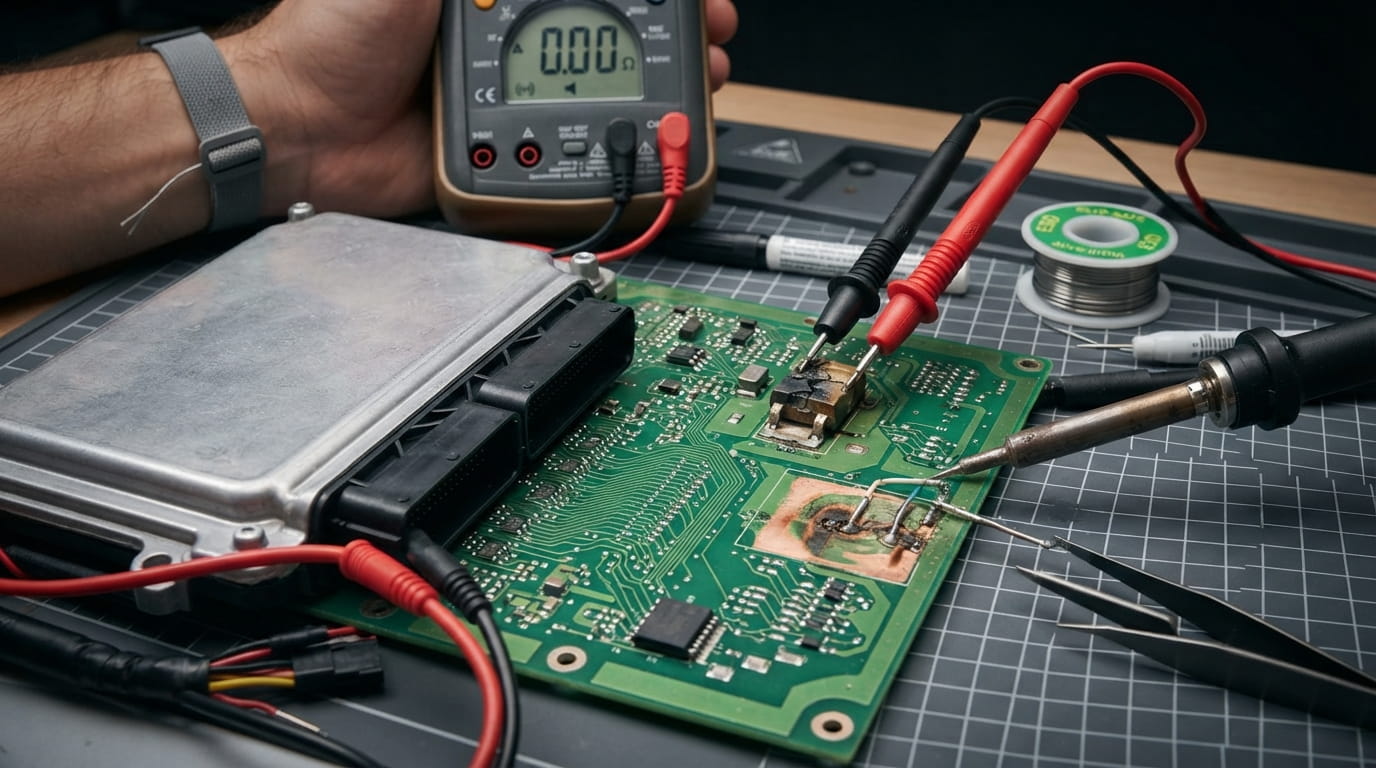
Step 2: Test the ABS Sensor with a Multimeter
If you've isolated the problem to a specific wheel, you can verify the sensor's health using a digital multimeter.
For Passive (Two-Wire) Sensors:
-
Safely jack up the vehicle and remove the wheel to access the sensor connector. Disconnect the harness.
-
Set your multimeter to the Ohms setting.
-
Touch the multimeter probes to the sensor terminals. Check your service manual for the exact specification, but a healthy passive sensor typically reads between 800 and 2000 ohms. An infinite reading (OL) means an internal break, while zero indicates a short.
-
Switch your meter to AC Volts, spin the wheel rapidly by hand, and watch for a fluctuating millivolt signal indicating the sensor is generating power.
For Active (Hall-Effect) Sensors:
- Active sensors require power from the vehicle computer to operate. Testing them requires back-probing the connector with the ignition ON to check for reference voltage 5V or 12V and watching for a square-wave signal switch as the wheel rotates.
Step 3: Inspect for Wiring Harness Breaks
Many times, the sensor itself is completely fine, but the wiring leading to it has failed due to constant suspension movement and steering articulation.
-
The Problem: Constant bouncing up and down stresses the flexible harness in the wheel arch, leading to internal copper strand fractures.
-
The Fix: Perform a thorough ABS sensor wire break repair. Trace the wiring from the sensor anchor up to the inner fender well. Look for chaffing, tight pulling during full steering lock, or green corrosion inside connector pins. Solder and heat-shrink any broken strands rather than relying on standard electrical tape.
Step 4: Clean Tone Rings and Reluctance Wheels
-
If your electrical tests check out, the issue might lie in how the sensor reads rotation.
-
Over time, metallic brake dust, road debris, and rust flakes accumulate on magnetic tone rings or axle-integrated reluctance wheels. This debris distorts the magnetic field, causing erratic signals.
-
Locate the metal toothed ring (tone ring) attached to the CV axle, wheel hub, or brake rotor.
-
Use a wire brush, brake cleaner, and compressed air to carefully clean tone ring ABS sensor gaps.
-
Rotate the hub completely to check for cracked, chipped, or missing teeth on the ring, which will also trigger an ABS light and require tone ring replacement.
Summary Checklist for ABS Troubleshooting
[ ] Scan computer for specific corner fault codes.
[ ] Safely jack up the vehicle and remove the wheel.
[ ] Test ABS sensor with multimeter for proper resistance or signal output.
[ ] Inspect wheel well wiring for tension stress and internal breaks.
[ ] Clean tone ring ABS sensor teeth of rust and metal shavings.
[ ] Reconnect components securely and clear latched ABS fault codes using diagnostic software.
Would you like to consult with us regarding your auto repair needs? Contact us for a no-obligation Chat. We're here to help.
If you know already have something in mind, we might have what you're looking for, please visit Tech and Bids to search for what you need.