CONSOLE THERMAL ARCHITECTURE

+-------------------------------------+   +-------------------------------------+
|          PLAYSTATION 5              |   |           XBOX SERIES X             |
+-------------------------------------+   +-------------------------------------+
| • Dynamic Clock (Up to 2.23 GHz)    |   | • Fixed Clock (1.825 GHz Locked)    |
| • 36 Compute Units (CUs)            |   | • 52 Compute Units (CUs)            |
| • Liquid Metal TIM Interface        |   | • High-Grade Thermal Paste (TIM)    |
| • Double-Sided 120mm Intake Fan     |   | • Central Vertical Chimney Flow     |
+-------------------------------------+   +-------------------------------------+
A. Raw Compute Capabilities (TFLOPS vs Clock Speeds)
Microsoft opted for a wide, low-frequency silicon design: 52 CUs locked at 1.825 GHz, delivering a raw theoretical output of 12.15 TFLOPS. Sony opted for a narrower, high-frequency design: 36 CUs dynamically boosted up to 2.23 GHz, generating 10.28 TFLOPS.
In real-world multi-platform titles, this raw compute gap rarely translates into an 18% advantage for Xbox. Sony's higher clock speed allows GPU rasterization pipelines to run faster, resulting in higher geometry processing throughput that often offsets the lower compute unit count. On the other hand, Xbox's higher compute unit count and lower clock speed allows the CPU to use more compute units to process the same amount of data, resulting in a higher raw compute capacity. In the end, the raw compute gap is not a significant differentiator between the two platforms. The primary differentiator is the thermal design, which provides a significant advantage to Xbox. The hardware comparison table below shows the key differences between the two platforms.
| Feature / Metric | PlayStation 5 (Standard / Slim) | Xbox Series X | Value Impact / Analysis |
|---|---|---|---|
| APU Compute Performance | 10.28 TFLOPS (36 CUs @ 2.23 GHz dynamic) | 12.15 TFLOPS (52 CUs @ 1.825 GHz locked) | Xbox holds ~18% higher raw GPU compute capacity. |
| System Memory & Bandwidth | 16 GB GDDR6 (Unified 448 GB/s) | 16 GB GDDR6 (10 GB @ 560 GB/s + 6 GB @ 336 GB/s split) | PS5 offers unified memory; Xbox offers higher peak GPU pool speed. |
| Internal Storage Architecture | Custom 825GB / 1TB PCIe Gen4 NVMe (5.5 GB/s raw) | Custom 1TB PCIe Gen4 Velocity NVMe (2.4 GB/s raw) | PS5 leads in raw uncompressed asset streaming speed. |
| Storage Expansion Cost & Openness | Standard M.2 NVMe SSD (~R3,200 - R4,500 for 2TB) | Proprietary CFexpress Expansion Card (~R9,500 - R13,500 for 2TB) | PS5 uses off-the-shelf M.2 SSDs, saving up to R6,000+ per 2TB upgrade. |
| Backward Compatibility & Enhancements | PS4 native (~99%); PS1-PS3 via streaming/select ports | Xbox One, 360, & Original Xbox (FPS Boost / Auto-HDR) | Xbox excels at legacy resolution & framerate enhancements. |
B. Thermal Dissipation Strategies
- PlayStation 5: Utilizes a custom Liquid Metal (Gallium-Indium alloy) Thermal Interface Material (TIM) between the APU die and copper heat sink baseplate. This provides exceptional thermal conductivity but requires strict seal manufacturing to prevent short circuits.
- Xbox Series X: Employs a unique split-motherboard "sandwich" layout wrapped around a heavy central aluminum chassis block with a massive vapor chamber, relying on standard thermal paste and a top 130mm axial exhaust fan operating on a natural chimney airflow model.
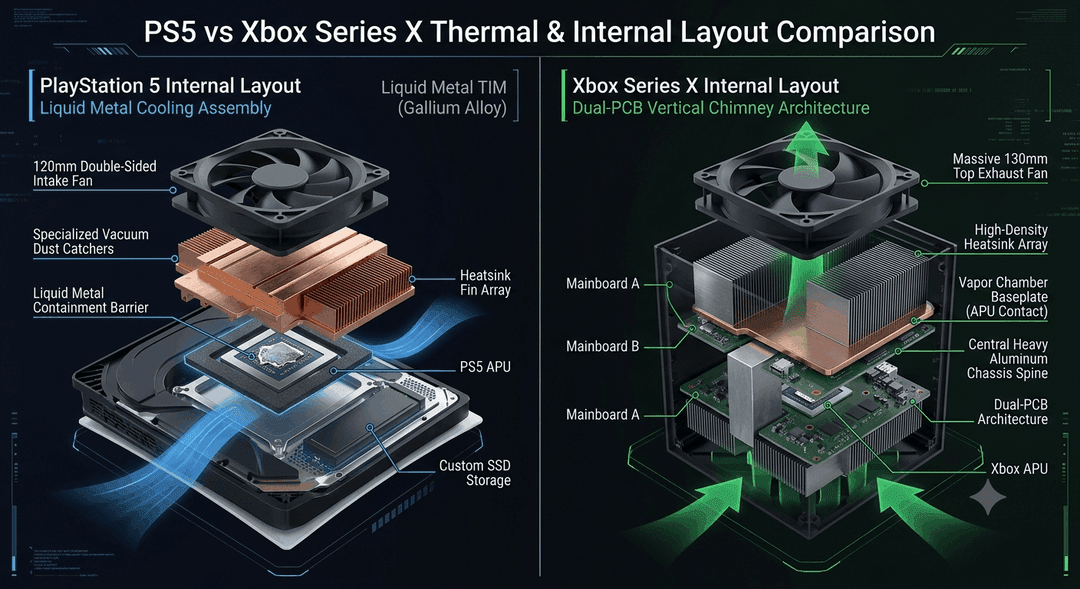
Figure 1: Internal structural breakdown illustrating the PlayStation 5 liquid metal cooling assembly (Left) versus the Xbox Series X dual-PCB vertical chimney architecture (Right).
2. Storage Expansion Economics: M.2 NVMe vs. Proprietary Expansion
One of the most significant financial divergences between the two consoles lies in secondary storage expansion. Modern 9th-gen games routinely exceed 100 GB in install size, making internal storage upgrades almost mandatory over a console's lifecycle.
The Financial Impact of Open Standards vs Proprietary Hardware
Sony adopted an open platform standard for the PS5, equipping every console with a standard PCIe Gen4 x4 M.2 NVMe slot. South African gamers can purchase off-the-shelf SSDs from standard PC components retailers (such as Wootware, Evetech, or Takealot), provided the drive meets a minimum 5500 MB/s read speed.
Microsoft chose a proprietary format co-developed with Seagate and Western Digital, relying on a custom CFexpress-derived expansion card slot that suffers from heavy import premiums and limited local distributor availability.
5-Year Storage Upgrade Cost Comparison (Local SA Pricing):
- PS5 2TB NVMe SSD (Gen4 7000MB/s with Heatsink): ~R2,800 – R4,200 (Prices dropped significantly due to open market competition across multiple brands).
- Xbox Series X 2TB Expansion Card (Proprietary): ~R11,000 – R13,500 (Extremely high local pricing maintained due to single-source manufacturing and import tariffs).
Value Takeaway: For local gamers expanding internal storage by 2TB or more, the PlayStation 5 yields an immediate R7,000+ savings in hardware upgrades over the Xbox Series X due to competitive M.2 SSD availability in South Africa.
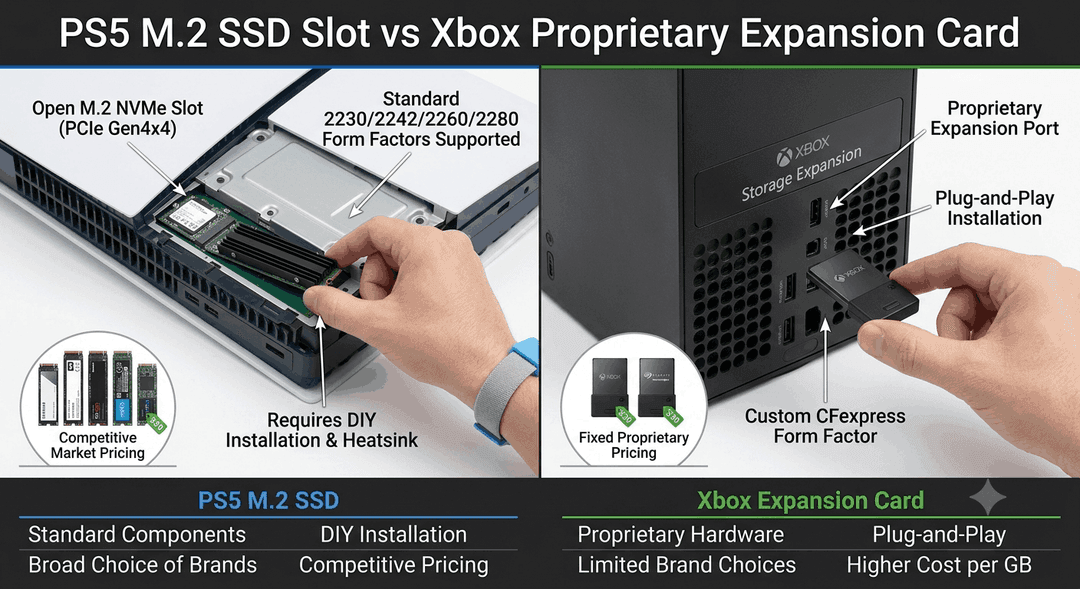
Figure 2: Physical storage comparison: Standard PCIe Gen4 M.2 NVMe SSD installed in the PS5 expansion bay (Top) versus the proprietary Xbox Series X expansion card format (Bottom).
3. Subscription Ecosystem Value: Xbox Game Pass vs. PlayStation Plus
A console's hardware value is tied directly to the software distribution platform powering it. Both platforms offer multi-tiered subscription services, but their economic philosophies differ substantially in the local market.
A. Xbox Game Pass Ultimate: The Day-One First-Party Engine
Xbox Game Pass Ultimate (R239/mo | ~R2,868/yr) remains the cornerstone of Microsoft's value proposition in South Africa.
- Strengths: Includes every Microsoft first-party title (Xbox Game Studios, Bethesda, Activision-Blizzard) on Day One of release at no extra cost (e.g., Call of Duty, Starfield, Forza, Halo). Includes PC Game Pass and EA Play integration.
- Weakness: Higher annual recurring cost compared to PS Plus Extra.
B. PlayStation Plus Extra / Deluxe: The Library Deep-Dive
Sony offers PS Plus Extra (R1,869/yr) and PS Plus Deluxe (R2,199/yr) in South Africa. (Note: South Africa receives the Deluxe tier instead of Premium due to cloud-streaming infrastructure limits, offering downloadable legacy games at a lower cost).
- Strengths: Provides instant access to hundreds of top-tier PS4 and PS5 titles, including blockbuster exclusives (God of War Ragnarök, Horizon Forbidden West, The Last of Us Part I) approximately 12 to 18 months after retail launch.
- Weakness: New major first-party releases are not included on Day One; users must still purchase new Sony AAA titles at R1,299 to R1,399 retail.
                 3-YEAR TOTAL SUBSCRIPTION SPEND

PlayStation Plus Extra (R1,869/yr x 3)   : R5,607
Xbox Game Pass Ultimate (R2,868/yr x 3) : R8,604   [+R2,997 Difference]
Economic Verdict: If you purchase 3 to 4 full-price AAA first-party games per year on Day One, Xbox Game Pass Ultimate pays for itself. However, if you prefer patient gaming through a deep catalog of historical blockbusters, PS Plus Extra provides a lower entry price.
The table below summarizes the ecosystem value proposition for the PlayStation 5 and Xbox Series X:
| Feature / Metric | PlayStation 5 (Standard / Slim) | Xbox Series X | Value Impact / Analysis |
|---|---|---|---|
| Entry-Level Multiplayer Tier | PS Plus Essential (R1,109/yr | R139/mo - 3 monthly games, cloud saves) | Xbox Game Pass Core (~R999/yr | R99/mo - 25+ curated games catalog) | Xbox Core is ~R110/yr cheaper for basic online play. |
| Flagship On-Demand Catalog | PS Plus Extra / Deluxe (R1,869 - R2,199/yr) | Xbox Game Pass Ultimate (R2,868/yr | R239/mo) | Xbox includes Day-One first-party titles; PS5 offers deep post-launch AAA catalog. |
| Hardware Thermal & Serviceability | Liquid metal TIM, vacuum dust catchers, modular drive (Slim) | Standard thermal paste, dual-PCB vertical chimney channel | Xbox is easier to repaste DIY; PS5 features built-in vacuum catchers. |
4. Hardware Longevity, Dust Accumulation, and Repairability
From an electronics maintenance perspective, long-term durability directly impacts resale value and lifetime service costs.

Figure 3: Hardware serviceability setup: PS5 dedicated dust extraction catchers (Left) alongside the Xbox Series X fan chimney housing and thermal paste interface (Right).
Maintenance & Serviceability Breakdown:
-
Dust Management:
- PS5: Includes engineered dust catcher holes beneath the faceplates. Users can safely vacuum accumulated dust clumps without disassembling the main chassis or breaking warranty seals.
- Xbox Series X: The vertical chimney intake pulls air in through the bottom rear and pushes it out the top. While highly efficient, fine dust settles heavily on the internal power supply module at the bottom. Cleaning requires removing the rear housing.
-
Thermal Paste Degradation & Repasting:
- Xbox Series X: Uses standard silicone-based thermal paste over the APU die. Over 4–5 years, thermal paste dries out, but can be easily cleaned with 99% Isopropyl Alcohol and repasted by any competent repair technician.
- PS5: Uses Liquid Metal (Gallium Alloy). Liquid metal does not dry out over time like standard paste. However, if the console experiences severe mechanical drops, the liquid metal can pool unevenly or escape its foam containment barrier, creating severe hot spots or motherboard shorts that require specialist repair.
-
Modular Component Replacement:
- PS5 Slim: Features a fully detachable optical disc drive that plugs directly into the digital chassis, vastly improving repairability if the optical laser assembly fails.
- Xbox Series X: The optical drive is cryptographically paired to the main motherboard PCB via a daughterboard, requiring soldering techniques to swap drives while preserving key handshake codes.
5. Comparative Value Matrix & Final Decision Framework
To determine which console provides higher total value for your specific gaming habits, evaluate the decision matrix below:
| Feature / Scenario | PlayStation 5 Winner | Xbox Series X Winner | Financial & Hardware Rationale |
|---|---|---|---|
| Initial Console Cost (R13,999 RRP) | Tie | Tie | Identical entry pricing for standard disc editions. |
| Storage Upgrade Cost (2TB) | ✓ PS5 | — | Open M.2 SSD market saves R1,800+ over proprietary cards. |
| Day-One AAA Game Savings | — | ✓ Xbox | Game Pass delivers R1,300 titles at no added charge on day one. |
| Catalog Depth / Exclusive Score | ✓ PS5 | — | Superior historical review scores for Sony 1st-party exclusives. |
| Backward Compatibility Features | — | ✓ Xbox | Auto-HDR, FPS Boost, and native execution for 4 generations. |
| Controller Features & Haptics | ✓ PS5 | — | DualSense features adaptive triggers and advanced haptics. |
| DIY Thermal Maintenance | — | ✓ Xbox | Standard thermal paste layout is safer for DIY maintenance. |
Conclusion & Verdict
There is no single "winner" for every gamer—the value proposition depends entirely on how you consume media and manage hardware upgrades:
- Choose the PlayStation 5 if: You value cutting-edge immersive controller haptics (DualSense), want to save significant money on open-market M.2 SSD storage upgrades, prefer Sony's critically acclaimed cinematic single-player exclusives, and appreciate built-in vacuum dust catchers for simple surface maintenance.
- Choose the Xbox Series X if: You want maximum raw TFLOPS compute performance, play games across multiple generations (OG Xbox through Series X), want the highest subscription ROI through Day-One first-party releases on Game Pass Ultimate, and prefer a straightforward, easy-to-repaste hardware chassis.
By analyzing both the upfront purchase cost and total cost of ownership over a 5-year lifecycle, you can select the console platform that best aligns with your gaming budget and technical expectations.
Visit Tech and Bids for your next gaming console upgrade.