For years, Apple MacBooks have been the gold standard for independent creators, software developers, and corporate professionals across South Africa. Their sleek aluminum unibodies and efficient Apple Silicon architecture make them formidable workhorses. However, a dark cloud hangs over the premium user experience: the sheer, maddening impossibility of independent hardware repair.
If you break a modern MacBook in South Africa, you are immediately forced into a hostile ecosystem designed to push you toward replacement rather than restoration. Between aggressive component serialization and a lack of local infrastructure, third-party technicians face an uphill battle.
Here is an analytical breakdown of why repairing a modern MacBook has become a near-impossible feat, especially within the South African landscape.
1. The Silicon Gatekeepers: T2 Security Chip Features & Apple Silicon
The shift away from highly modular laptops started years ago, but it solidified with the introduction of proprietary security co-processors. Understanding T2 Security Chip features is central to understanding why independent hardware modification is dead.
While Apple accurately markets the T2 chip (and its subsequent integration into M-series Apple Silicon) as a win for user data encryption and secure boot capabilities, it simultaneously functions as a digital lock on the hardware itself.
- Hardware-to-Silicon Binding: The security chip cryptographically pairs vital components—such as the Touch ID sensor, FaceTime camera, display, and even the logic board itself—to one specific machine.
- The Kill-Switch Effect: If a technician swaps a faulty screen with an identical screen from another donor MacBook, the security architecture flags the component mismatch. Without proprietary validation software, the laptop may disable True Tone, kill webcam functionality, or refuse to boot entirely.
Hardware Serialization Barriers
| Component to Repair | Dependency / Gatekeeper | Consequence for Independent Repair |
|---|---|---|
| **Logic Board / Power Rail** | T2 / M-Series Crypto-pairing | Board swaps cause activation locks; component-level schematics are heavily restricted. |
| **Liquid Damaged Keyboard** | Riveted Chassis & Touch ID Binding | Replacing the keyboard requires drilling out dozens of rivets or swapping the expensive entire top case assembly, which risks breaking Touch ID functionality. |
| **Cracked Display Panel** | Lid Angle Sensor & Screen Serialization | Replacing the screen panel without Apple’s calibration utility causes artifacting, sleep-cycle failures, or disabled True Tone. |
| **Dead Battery** | Aggressive Structural Adhesives | Glued-in batteries risk thermal runaway or puncture if extracted without specialized solvent tools. |
2. The Logistics Desert: Replacement OEM Parts Availability
In North America or Europe, consumers can occasionally leverage self-service repair programs or tap into massive local distribution networks for reclaimed parts. In South Africa, the landscape is bleak due to strictly managed replacement oem parts availability.
Apple does not sell genuine, individual replacement parts to independent repair shops unless they join the highly restrictive Independent Repair Provider (IRP) program. For many local boutique shops, the IRP program's high overheads, mandatory audit trailing, and pricing structures make it unviable.
[Apple Central Warehouse]
│
▼ (Restricted Supply Chain)
[Authorised Service Providers (ASPs)] ──► Exorbitant "Board Swap" Pricing
│
▼ (Zero Official Supply)
[Independent SA Repair Shops] ──────────► Reliant on Gray Market / Donor Units
Consequently, South African technicians are left with two subpar choices:
- Harvesting Donor Units: Stripping broken or liquid-damaged MacBooks for intact components. However, because of the serialization mentioned above, donor parts are becoming increasingly useless.
- Importing Gray-Market Components: Sourcing third-party replicas or extracted OEM parts via international freight from Asia. This introduces massive shipping delays, customs duties, and the constant risk of counterfeit components getting seized at the border.
3. The Digital Lock: Programming and Device Unlocking Required for Simple Repairs
We have long passed the era where turning a screwdriver was enough to complete a laptop repair. Today, programming and device unlocking required for simple repairs turns minor physical fixes into complex software engineering puzzles.
Even if a local technician miraculously sources a pristine OEM replacement part, the repair is only half-finished. To make the machine fully functional, the hardware must be digitally "blessed" by Apple's cloud servers.
The Repair Calibration Dilemma
When an Authorized Service Provider completes a repair, they connect the machine to a proprietary cloud suite (such as Apple System Configuration). This software communicates with Cupertino to rewrite the security enclaves on the device, accepting the new serial numbers.
Without access to this software, independent South African shops must resort to complex workarounds:
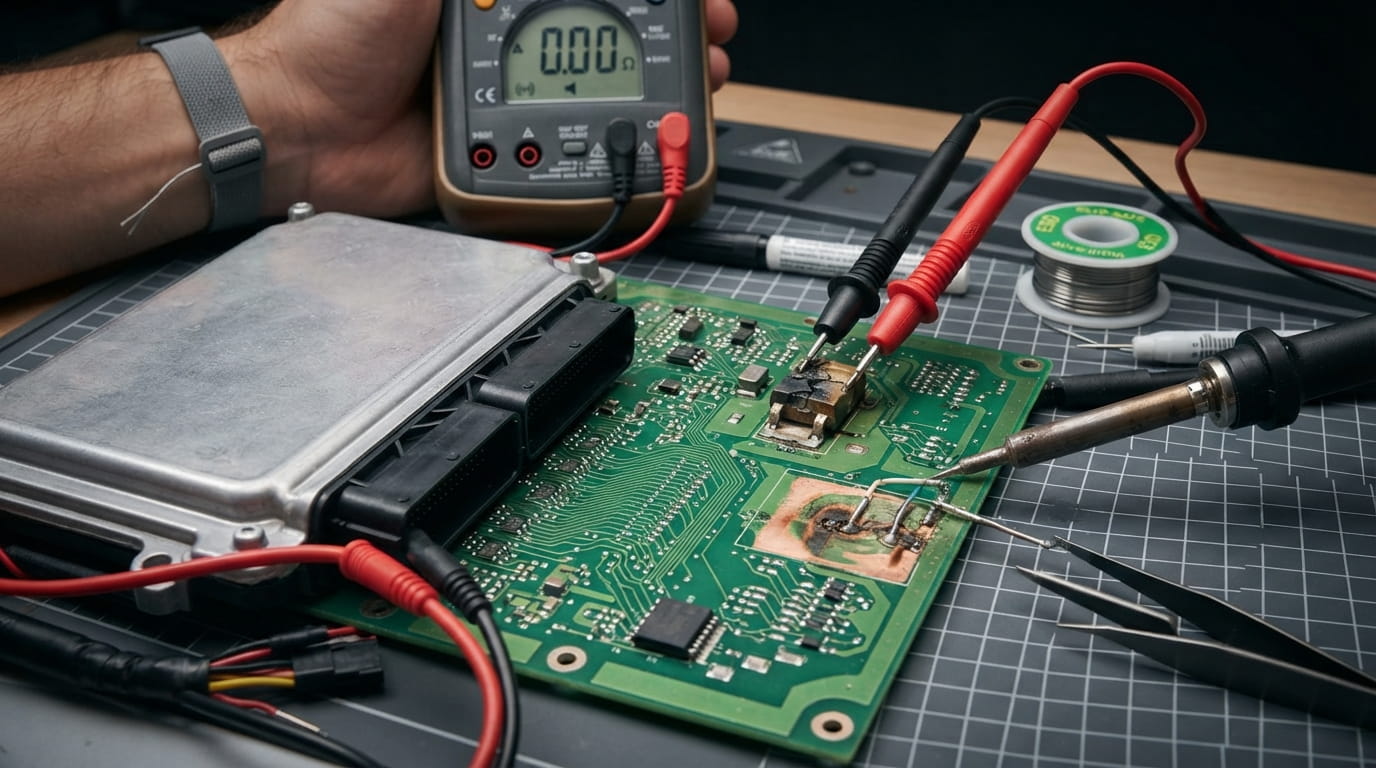
- Desoldering and Re-programming EEPROM Chips: Technicians must physically desolder tiny microchips from the old broken part and solder them onto the new replacement part to preserve the original serial number configuration.
- Data Migration via Micro-soldering: Fixing a corrupted storage drive or shorted power rail often requires micro-soldering under a microscope to move physical NAND flash chips or override firmware-level locks.
This shifts the barrier of entry from basic mechanical competency to advanced engineering, driving up repair costs and reducing the number of local shops capable of executing the work safely.
4. The South African Consumer Tax: "Just Buy a New One"
The convergence of these artificial repair barriers creates a frustrating economic reality for South Africans. When an out-of-warranty MacBook suffers a failure—even something as simple as a degraded battery or a blown capacitor from a local power surge—the quote from Authorized Service Providers is routinely shocking.
Because official channels prefer replacing entire multi-component sub-assemblies (e.g., replacing the entire logic board, RAM, and storage over a single broken port), repair estimates often reach 70% to 90% of the cost of a brand-new machine.
Ultimately, Apple's locked-down ecosystem forces an artificially short lifecycle onto incredibly capable hardware, leaving South African consumers with expensive aluminum paperweights and fewer rights to the devices they rightfully own.
Summary Checklist: Navigating a Broken MacBook in SA
If your MacBook stops booting or suffers physical damage, use this checklist to assess your options rationally before committing to a costly path forward:
- [ ] Check Warranty and AppleCare+ Status: If you are within the coverage window, do not let an independent shop open the chassis; dynamic security logs will immediately void your remaining coverage.
- [ ] Identify the Gatekeeper Component: Determine if the broken element involves serialized sub-components (Touch ID, Display, Logic Board) that will trigger software calibration locks.
- [ ] Evaluate Independent Capabilities: If opting for a third-party repair shop, explicitly ask if they possess micro-soldering diagnostic equipment and if they can safely transfer original IC chips to retain device functionality.
- [ ] Weigh Board-Level Repair vs. Replacement: If an authorized center quotes you for a full logic board replacement, seek a reputable local specialist who offers component-level microscopic diagnostics—it could mean the difference between a R15,000 board swap and a R2,000 capacitor replacement
Experiencing a similar issue? Contact us for a no-obligation quote. We're here to help.