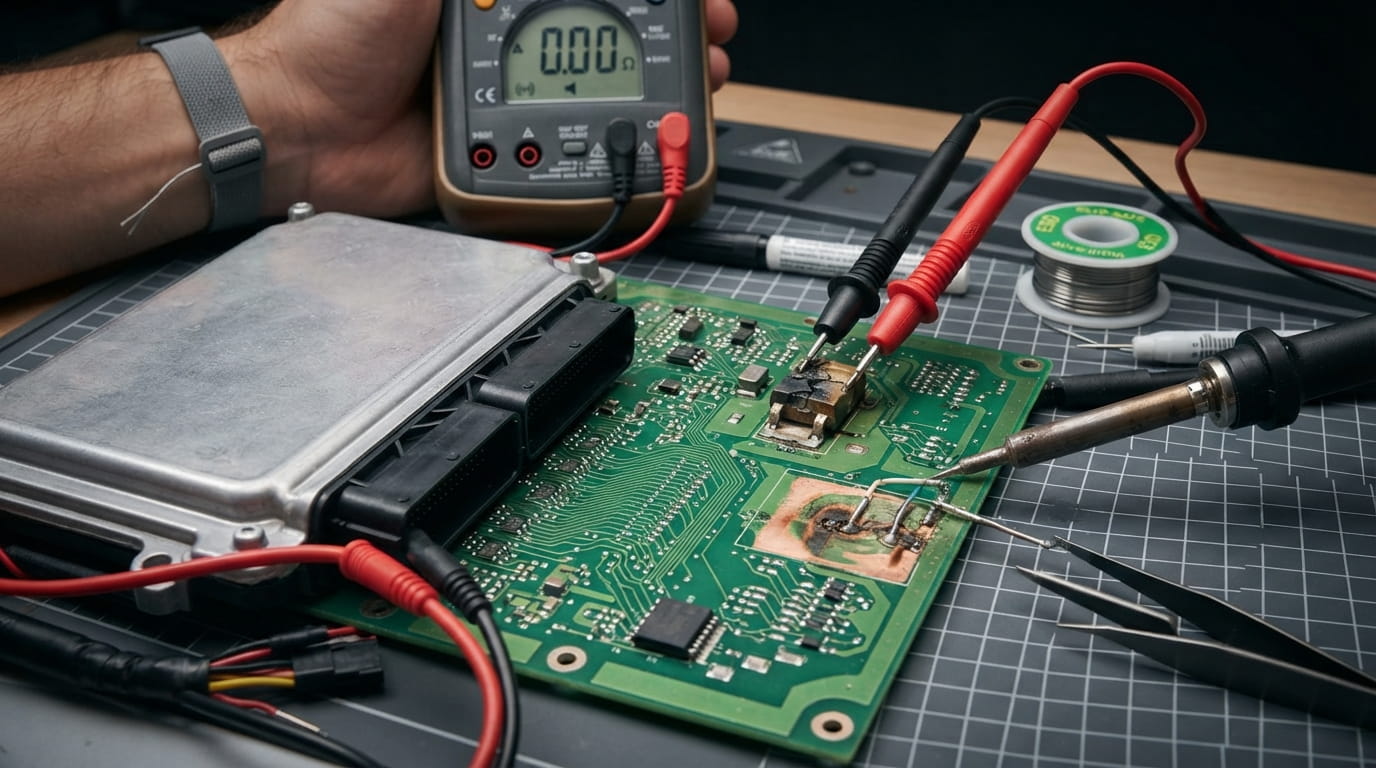
Inside of a dbx 286 preamp
If you’ve imported a dbx (by Harman) microphone preamp from the United States or Japan, you’ve likely encountered a significant hurdle: the device is designed for 110V-120V AC mains, while South Africa operates on a 230V / 50Hz standard.
Plugging a 110V device directly into a 230V outlet without proper conversion will almost instantly destroy the primary winding of the transformer, and potentially cascade damage to the rectification and regulation stages. While an external step-down transformer is a safe short-term solution, the cleanest, most permanent fix is to replace the internal dual-rail linear DC power supply transformer.
This guide walks through the process of converting a standard dbx preamp (such as the 286s, 386, or similar 500-series chassis) to run natively on South African mains.
Prerequisites & Safety Warnings
DANGER: HIGH VOLTAGE Working with mains voltage (230V) can be fatal. This guide is intended for qualified technicians or advanced hobbyists with experience in linear power supplies.
- Unplug the unit and wait for capacitors to discharge before working.
- Verify your work with a multimeter before powering on.
- If you are unsure about any step, consult a professional electronics repair shop.
Tools & Materials
- Replacement Transformer: A 230V primary to dual-secondary (or center-tap) transformer matching the original specifications.
- Soldering Station with appropriate tip size.
- Multimeter with capacitance and continuity testing.
- Wire Strippers / Cutters.
- Heat Shrink Tubing or electrical tape.
- Screwdriver set (usually Phillips or Torx for dbx chassis).
- Schematic for your specific dbx model (available from Harman Professional support).
1. Identifying the Original Transformer Specifications
Most dbx microphone preamps utilize a linear dual-rail power supply. This means the original transformer is not a simple single-voltage type. You must identify the secondary voltage requirements before sourcing a replacement.
Open the chassis and locate the main power transformer. Look for the following markings:
- Part Number: Often a Harman-specific code (e.g.,
T110-001). - Secondary Voltages: Linear supplies for op-amps typically require ±15V or ±17V DC after regulation. To achieve this, the transformer secondaries are usually rated for 15V-0V-15V (center-tapped) or two separate 15V secondaries.
How to Determine the Required Secondary Voltage
- Look at the main filter capacitors: Find the large electrolytic capacitors after the rectifier bridge. If they are rated for 25V or 35V, the DC rail is likely ±15V. The AC voltage from the transformer is approximately:
V_AC = V_DC / 1.414. So for ±15V DC, you need roughly ±12V AC. - Check the voltage regulators: Look for 7815 (positive 15V) and 7915 (negative 15V) regulators. If these are present, you need an AC secondary voltage between 15V and 18V to allow for regulator headroom.
- Original Transformer Spec: A common spec for these units is a 115V primary with dual 15V secondaries (30V CT) rated between 20VA and 30VA.
2. Sourcing the Correct 230V Transformer
You need a transformer with the following characteristics:
- Primary: 230V (or dual 115V primaries that can be wired in series for 230V operation).
- Secondary: Dual secondaries or a center-tapped secondary that matches the original.
- VA Rating: Equal to or greater than the original VA (Volt-Amps). If the original was 25VA, a 30VA replacement is acceptable.
- Physical Size: It must fit within the existing chassis footprint and mounting holes.
Recommended Transformer Types
| Type | Description | Suitable For |
|---|---|---|
| Dual Primary / Dual Secondary | Two 115V primaries (wired in series for 230V) and two independent 15V secondaries. | Modern replacements for dbx 286s, 386. |
| Single Primary / Center-Tapped | One 230V primary with a secondary of 30V (15V-0V-15V). | Older dbx units or compact chassis. |
Where to buy in South Africa:
- RS Components (rs-online.com): Search for "30VA toroidal transformer 230V 15V".
- Mantech Electronics: Stock local chassis-mount transformers.
- Toroidal transformers (donut-shaped) are often quieter (lower EMI) than laminated EI-core types, which is beneficial for microphone preamps.
3. Step-by-Step Replacement Procedure
Step 1: Disassembly & Discharge
- Remove the top cover and any internal shielding.
- Discharge the main filter capacitors. Use a 1kΩ, 5W resistor or a discharge tool across the leads of the large power supply capacitors. Verify with a multimeter that voltage is below 1V.
Step 2: Document & Remove the Original Transformer
- Take clear photos of the wiring before desoldering.
- Note color coding: US standard transformers often use:
- Black / White: Primary (110V)
- Red / Red: One secondary winding.
- Yellow / Yellow: Another secondary winding (or Blue/Blue).
- Desolder the primary wires from the AC input (mains) side (often near the IEC power inlet or fuse holder).
- Desolder the secondary wires from the rectifier board (bridge rectifier or diode array).
- Remove the mounting bolt and lift out the old transformer.
Step 3: Mount the New Transformer
- If using a toroidal transformer, you will need a centering washer and rubber padding to avoid shorting the toroid’s core to the chassis.
- If using an EI-core, ensure it mounts securely with the original bracket or a new one.
- Critical: Ensure the mounting bolt does not create a short circuit (ground loop) with the chassis.
Step 4: Wire the Primary (230V Side)
For a transformer with dual 115V primaries, you must wire them in series for 230V:
- Primary 1: 0V (usually Black)
- Primary 2: 115V (usually Black/White or Brown)
- Configuration:
- Connect Live (Brown) from the IEC inlet to Primary 1 (0V) .
- Connect Primary 1 (115V) to Primary 2 (0V) . (This is the series link).
- Connect Primary 2 (115V) to Neutral (Blue) .
- Connect the Earth/Ground (Green/Yellow) directly to the chassis.
📐 Primary Wiring Diagram (Series for 230V)
IEC Inlet                     Transformer
┌─────────┐                   ┌─────────┐
│ L (Brn) ├───────────────────┤ P1 (0V) │
│         │                   │         │
│         │    ┌──────────────┤ P1 (115V)│
│         │    │              └─────────┘
│         │    │              ┌─────────┐
│         │    └──────────────┤ P2 (0V) │
│         │                   │         │
│ N (Blu) ├───────────────────┤ P2 (115V)│
│         │                   └─────────┘
│ E (Grn) ├─────── Chassis Ground
└─────────┘
Step 5: Wire the Secondary
Connect the secondary wires exactly as the original was configured. If the original used a bridge rectifier with two separate secondaries, wire them accordingly.
- Center-tapped (15V-0V-15V): The center tap goes to ground. The two outer wires go to the bridge rectifier AC inputs.
- Dual Secondaries: If the original had two separate rectifier circuits (or a single bridge with four diodes for a bipolar supply), replicate that configuration. Mistaking the secondary phasing will result in 0V output. If unsure, measure AC voltage between the two secondaries before connecting to the rectifier—you should see 0V if they are in phase, or 30V if they are out of phase.
Step 6: Double-Check & Test
- Continuity Check: Before powering on, use a multimeter in continuity mode to ensure there are no shorts between:
- Primary wires and chassis.
- Secondary wires and chassis.
- Primary and secondary windings.
- Fuse Rating: Replace the original fuse (rated for 110V) with one appropriate for 230V. The current rating should be halved. If the original was T1A (1 Amp) at 110V, replace with T500mA (0.5 Amp) at 230V. Check the service manual for the exact value.
4. First Power-On & Validation
- Use a Variac (if available): Gradually bring the voltage up from 0V to 230V while monitoring current draw.
- Without Variac: Plug the unit in and power it on while keeping your hand on the power switch, ready to turn it off immediately.
- Measure DC Rails:
- Probe the main filter capacitors. You should see approximately ±18V to ±22V DC (unregulated).
- Probe the output of the voltage regulators (7815/7915). You should see a stable +15V and -15V.
- Listen & Smell: The transformer should run silent (no mechanical hum) and not heat up rapidly.

Preamp with replacement transformer.
5. Final Assembly & Conclusion
If the DC rails are correct, the unit is stable, and no excessive heat is present:
- Power off and unplug.
- Secure any loose wiring with zip ties.
- Reinstall the chassis cover and shielding.
- Perform a functional test with a microphone and audio interface.
Congratulations. Your dbx preamp is now permanently converted to run natively on South Africa’s 230V / 50Hz mains. This conversion maintains the original audio path integrity, eliminates the need for external step-down transformers, and ensures safe, long-term operation in a local studio or live sound environment.
Frequently Asked Questions
Can I just change the fuse?
No. Changing the fuse only protects against overcurrent. Without changing the transformer, applying 230V will saturate the 110V primary winding magnetically, causing it to overheat and fail within seconds.
What about 50Hz vs 60Hz?
Most linear transformers designed for 60Hz will operate safely at 50Hz, though they may run slightly warmer. If you source a new 230V transformer, ensure it is rated for 50Hz (which is standard in South Africa).
What if my dbx unit has a switch-mode power supply (SMPS)?
Some newer dbx units use universal switching power supplies that automatically accept 100V-240V. Check the label near the IEC inlet. If it says "100-240V AC," no conversion is needed. This guide applies specifically to units with a linear (transformer-based) power supply.